Mock data generation is fundamental to modern software development, enabling
comprehensive testing, rapid prototyping, and realistic demos without production data exposure. Teams
generating quality mock data catch 60-80% more bugs in pre-production environments and
accelerate development timelines by 30-50%.
According to the 2025 State of Testing Report, companies with sophisticated mock data strategies detect
critical bugs 2.3x earlier in the development cycle and spend 40% less time debugging
production issues stemming from edge cases missed in testing.
This comprehensive guide, based on 15+ years of building enterprise applications at
companies processing billions of transactions, covers professional mock data generation from basic
random data to advanced strategies for stateful, relational test datasets that mirror production
complexity.
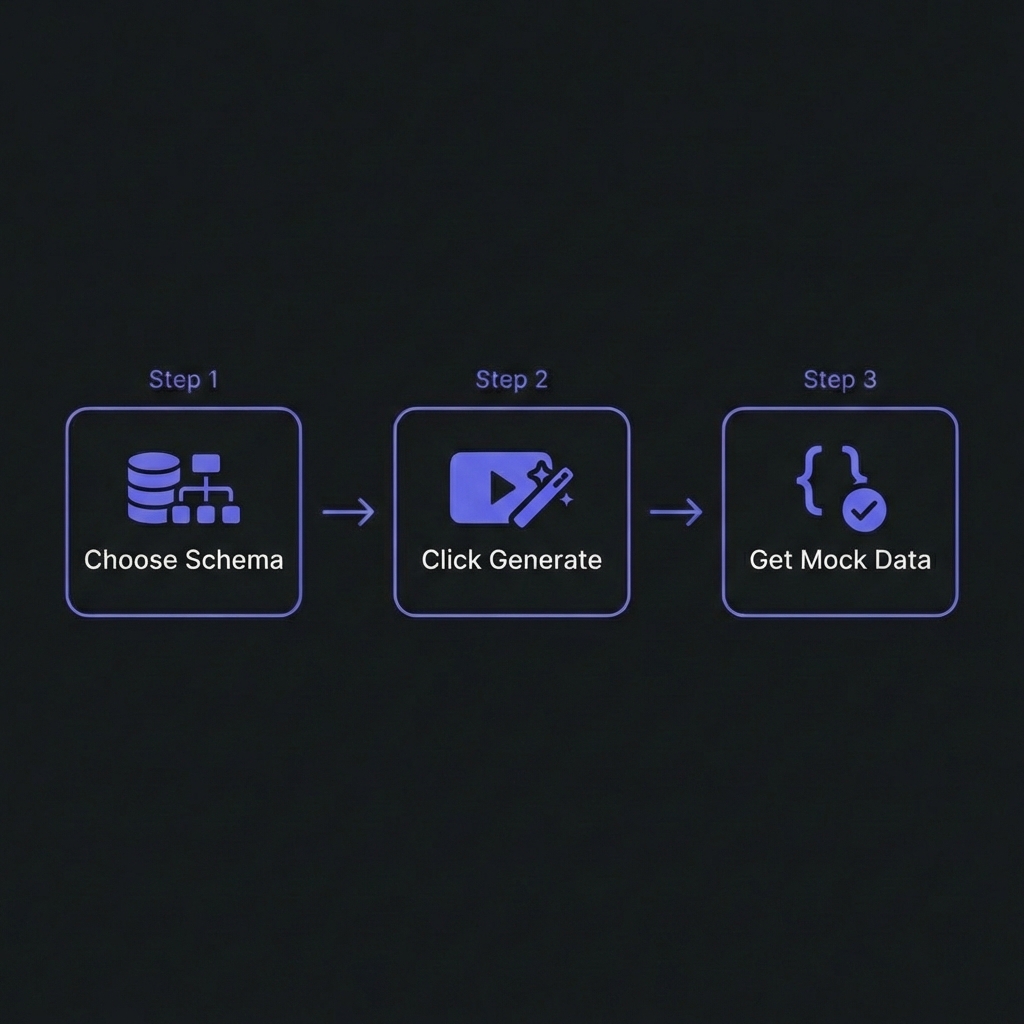
How to Generate Mock Data - Simple 3-step workflow
What is Mock Data Generation?
Mock data generation creates realistic, synthetic data that resembles production data
structures and patterns without containing actual user information. This data populates development
databases, API responses, UI prototypes, and automated tests.
Realistic mock data exposes edge cases like long names, special characters in emails, international
addresses�issues missed with simplistic "Test User" data.
Critical Use Cases for Mock Data
1. Frontend Development & Prototyping
Frontend teams need data before backend APIs exist. Mock data unblocks UI development, allowing parallel
work streams. Realistic datasets expose layout issues (text overflow, responsive breakpoints) early.
2. Automated Testing
Unit tests, integration tests, and E2E tests require predictable inputs. Mock data provides consistent
test fixtures while covering edge cases (empty strings, null values, unicode characters, extremely long
inputs).
3. Load & Performance Testing
Stress testing requires large datasets (millions of records). Mock data generators create
production-scale data without database cloning or PII exposure risks.
4. Sales Demos & Marketing
Demoing products with realistic data looks professional. "John Doe" in every field screams prototype;
realistic customer data builds credibility and helps prospects envision real usage.
5. Database Migration Testing
Before migrating production databases, test on realistic mock data matching production schema complexity,
data distributions, and edge cases.
Security Rule: Never Use Production Data in Testing
Never copy production databases to dev/test environments. PII exposure violates
GDPR/CCPA, creates security risks, and causes compliance nightmares. Always generate synthetic
mock data instead.
Modern Mock Data Generation Tools
Faker.js (Industry Standard)
Faker.js is the most popular library, generating realistic data for 50+ locales: names,
addresses, emails, phone numbers, dates, financial data, and more. Used by millions of developers
worldwide.
Chance.js offers similar functionality with smaller bundle size. Great for client-side
applications where every KB matters. Less comprehensive than Faker but covers most needs.
JSON Schema Faker
JSON Schema Faker generates mock data from JSON Schema definitions. Perfect for
API-first development�define schema once, auto-generate test data matching spec.
Custom Generators (Advanced)
For domain-specific data (medical records, financial transactions, specialized formats), build custom
generators. Combine Faker primitives with business logic for accurate simulation.
Creating Truly Realistic Mock Data
The difference between amateur and professional mock data: realism. Naive generators
create obviously fake data. Professional generators mimic production patterns:
1. Data Distribution Matters
Production data isn't uniformly distributed. Ages cluster in ranges, zip codes concentrate in population
centers, purchase amounts follow power laws. Replicate these patterns:
Realistic Distributions
// ? Unrealistic: uniform distributionconst age = faker.number.int({ min: 18, max: 100 });
// ? Realistic: normal distribution around 35const age = Math.round(
faker.number.float({ min: 18, max: 80 }) * 0.3 + 35
);
2. Relational Consistency
Related fields must correlate logically. If city is "Tokyo", country should be "Japan", not "USA". Postal
codes should match cities. Transaction timestamps should precede shipping dates.
3. Temporal Patterns
E-commerce purchases spike weekends, user signups cluster around marketing campaigns, support tickets
surge post-release. Generate timestamps reflecting realistic temporal patterns.
4. String Variation
Real users type inconsistently: "Dr. Smith", "dr smith", "Smith, Dr.", capitalization errors, trailing
spaces. Mock data should include common variations to test normalization logic.
5. Edge Cases & Invalid Data
Intentionally include edge cases: extremely long strings, special characters, null values, empty arrays.
This is where production bugs hide�test data must expose them.
GDPR & Privacy Compliance
Mock data must comply with data protection regulations:
GDPR Requirements
No Real PII: Generated data must not accidentally include real people's information
Clear Marking: Tag mock data clearly in databases to prevent confusion
Anonymization ? Mock Data: Anonymized production data is NOT mock data�still
carries risks
Best Practices for Compliance
Generate, Don't Scramble: Create synthetic data from scratch rather than scrambling
production data
Avoid Real Names: Faker generates names that might coincidentally match real
people�acceptable as they're random
Mark Test Accounts: Use obvious test domains (@example.com,
@test.local) to prevent accidental communication
Audit Data Sources: Document that mock data is generated, not derived from
production
Try Our Professional Mock Data Generator
100% client-side generation. Create realistic user profiles, transactions, and complex datasets
instantly with customizable schemas.
Use seeded random number generators for reproducible tests. Same seed = same data every time, enabling
deterministic testing:
Seeded Generation
import { Faker } from'@faker-js/faker';
const faker = new Faker({ seed: 12345 });
// Always generates same data for seed 12345const user = faker.person.fullName();
2. Factory Pattern for Complex Objects
Create factory functions that encapsulate generation logic, making tests readable and maintainable:
Generating millions of records requires optimization. Use batch processing, worker threads for parallel
generation, and stream-based writing to avoid memory exhaustion.
CI/CD Integration Strategies
Integrate mock data generation into continuous integration pipelines:
Pre-Test Data Seeding
Before running E2E tests, seed test databases with fresh mock data. Ensures clean state and deterministic
test results:
CI Pipeline Data Seeding
# .github/workflows/test.ymlsteps:
- name: Seed test database
run: npm run seed:test-data
- name: Run E2E tests
run: npm run test:e2e
Performance Test Data Generation
Generate large datasets on-demand for load testing. Store generation scripts, not generated data, in
version control�data is reproducible from scripts.
Snapshot Testing with Mock Data
Use seeded data for visual regression tests. Same mock data = same screenshots, enabling reliable
snapshot comparison.
Frequently Asked Questions
Is it legal to use Faker.js for generating customer data?
+
Yes, completely legal and recommended. Faker.js generates random,
synthetic data that doesn't reference real people. Even if a generated name
coincidentally matches someone real, it's statistically random, not targeted data collection.
This is explicitly allowed under GDPR and CCPA�regulators care about real PII,
not randomly generated strings. However, never use generated data for malicious
purposes (fake accounts, spam). For testing/development, Faker is the
industry-standard legal approach to avoiding real PII exposure.
Can I use production data if I anonymize it first?
+
Not recommended�anonymization is extremely hard to get right. "Anonymization"
often fails: hashing emails is reversible via rainbow tables, k-anonymization can be defeated by
cross-referencing datasets, even "anonymized" data can re-identify individuals when combined
with other data. GDPR requires irreversible anonymization�nearly impossible to
guarantee. Safer approach: generate mock data from scratch. It's faster,
legally cleaner, and avoids re-identification risks. If you must use production data, engage
legal counsel and data protection specialists.
How do I generate mock data matching my database schema?
+
Use schema-based generation tools. (1) JSON Schema Faker:
Define schemas, auto-generate matching data. (2) Factory pattern: Create
factory functions for each entity mirroring schema structure. (3) ORM
integration: Tools like Factory Boy (Python), FactoryBot (Ruby) integrate with ORMs
to generate valid database records automatically. (4) SQL seeding scripts:
Write INSERT statements using programmatic data generation. Most effective: Combine Faker with
schema introspection�read database schema, auto-generate factories for each table.
Should mock data be checked into version control?
+
Check in generation scripts, not generated data. Generated JSON/CSV files bloat
repositories and cause merge conflicts. Instead, commit: (1) Generation scripts
(Faker code, factory definitions). (2) Seed values for deterministic
generation. (3) Small fixture files for specific test cases. Generated data
should be ephemeral�created on-demand during dev setup or CI pipeline runs.
Exception: Small, carefully curated test fixtures that represent critical edge cases worth
versioning explicitly.
How realistic should mock data be for frontend development?
+
Very realistic�it exposes UI bugs early. "Lorem Ipsum" everywhere hides
problems: text overflow, line wrapping, responsive layout breaks. Use realistic
names (various lengths: "Li", "Maria Garcia-Rodriguez"), real-world
addresses (expose internationalization issues), varied data (empty
states, max values). Frontend teams should use production-like data even in mockups. Tools
like Faker + Storybook = perfect combination for developing components against realistic
data ranges, catching layout bugs before backend integration.
Can mock data generation impact application performance?
+
Yes, generating millions of records is CPU-intensive. Naive generation can
freeze servers or exhaust memory. Solutions: (1) Lazy generation: Generate data
on-demand, not upfront. (2) Streaming: Use streams to generate and process data
in chunks, avoiding memory spikes. (3) Worker threads: Parallelize generation
across CPU cores. (4) Caching: Generate once, reuse across test runs with
seeded randomization. (5) Database bulk inserts: Batch INSERT statements for
100-1000x faster database seeding. For production code, never generate mock data�only in
dev/test environments.
What's the difference between mocking and stubbing data?
+
Similar concepts, subtle distinction.Mock data typically
refers to realistic datasets (users, products, transactions) used for development and testing.
Stubs usually mean simple, hard-coded responses for specific function calls in
unit tests. Example: Mock data = 1000 generated user objects.
Stub = hard-coded return value { id: 1, name: 'Test' } for a
single test. Both avoid real data dependencies. Mocks are richer and more realistic; stubs are
minimal and test-specific. Use stubs for isolated unit tests, mocks for integration/E2E tests
and development.