Hash Generator: The Complete Guide to MD5, SHA-256 & SHA-512 (2026)

Table of Contents
Hashing is the invisible force field that protects everything digital�from your bank password to the software update you just installed. It�s what allows data to be verified without being revealed, and it forms the bedrock of modern cryptography, blockchain, and cybersecurity.
However, not all hash functions are created equal. Using an obsolete algorithm like MD5 given the computing power available in 2026 is a recipe for disaster. This guide breaks down the mathematics, the security flaws, and the modern standards for cryptographic hashing, distilled from 15 years of cybersecurity experience.
What is Hashing? (One-Way Functions)
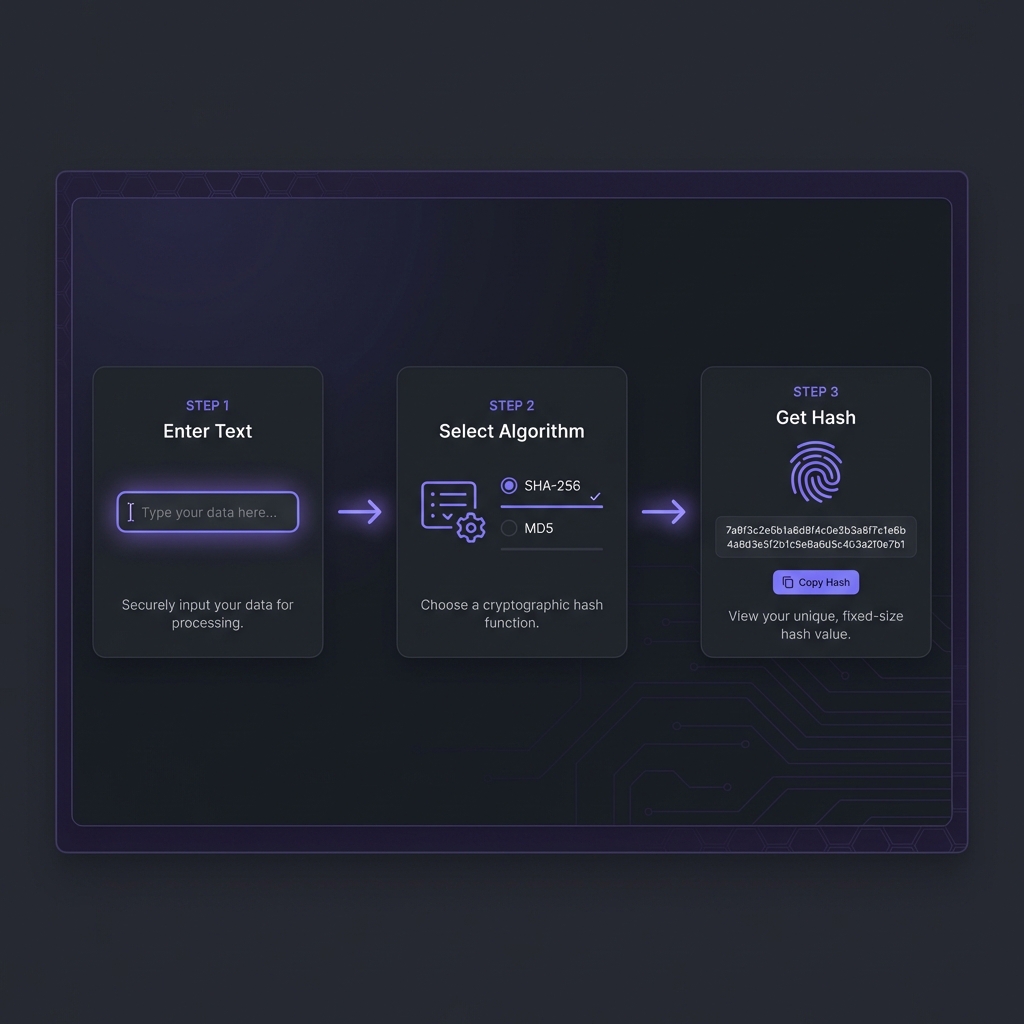
A hash function takes an input (or "message") of any length and transforms it into a fixed-length string of characters, called the "hash" or "digest."
The Golden Rules of Hashing
- Deterministic: The same input always produces the same output.
- Irreversible: You cannot reverse-engineer the original input from the hash (it's a "one-way" street).
- Unique (Avalanche Effect): Changing just ONE bit of the input should drastically change the entire output hash.
Input:  "Hello"
MD5:    8b1a9953c4611296a827abf8c47804d7

Input:  "hello" (Lowercase 'h')
MD5:    5d41402abc4b2a76b9719d911017c592

// Note: Totally different output for a tiny input change.
Algorithm Showdown: From MD5 to SHA-3
MD5 (Message Digest 5)
- Output: 128-bit (32 hex characters)
- Status: BROKEN / UNSAFE
- Use Case: Non-security checksums only (e.g., checking if a file download is corrupt). Never for passwords.
SHA-1 (Secure Hash Algorithm 1)
- Output: 160-bit (40 hex characters)
- Status: BROKEN / DEPRECATED
- History: Google shattered SHA-1 in 2017 with the SHAttered attack. Do not use.
SHA-256 (SHA-2 Family)
- Output: 256-bit (64 hex characters)
- Status: SECURE / STANDARD
- Use Case: SSL Certificates, Bitcoin, Modern Authentication. The industry workhorse.
SHA-512 (SHA-2 Family)
- Output: 512-bit (128 hex characters)
- Status: EXTREMELY SECURE
- Use Case: High-security environments where performance (on 64-bit CPUs) is key.
Password Hashing & Salting
Storing passwords in plain text is criminal negligence. But storing them as simple SHA-256 hashes is also dangerous because of Rainbow Tables (pre-computed lists of hashes for billions of common passwords).
The Solution: Salting
A "salt" is a random string added to the password before hashing. This ensures that two users with the same password (e.g., "password123") have different hashes.
// User A: Salt = "Xy9!"
Hash("Xy9!" + "password123") = a1b2...

// User B: Salt = "Qm7$"
Hash("Qm7$" + "password123") = z9y8...

// Result: Attacker cannot just look up "password123" in a table.
Best Practice
For passwords, speed is bad. Fast algorithms (like SHA-256) allow hackers to guess billions of passwords per second. Use slow, memory-hard algorithms like Bcrypt, Argon2, or PBKDF2 designed specifically for password storage.
File Integrity & Checksums
When you download a large file (like a Linux ISO or software installer), the website often lists a SHA-256 checksum. By hashing your downloaded file and comparing it to the listed checksum, you verify two things:
- No Corruption: The download completed successfully without bit rot.
- No Tampering: A hacker hasn't replaced the file with malware (a "Supply Chain Attack").
Generate Secure Hashes
Create MD5, SHA-1, SHA-256, and SHA-512 hashes instantly in your browser. No data leaves your device.
Open GeneratorThe Danger of Hash Collisions
A "collision" occurs when two different inputs produce the exact same hash. If an attacker can generate a malicious file that has the same hash as a legitimate file, they can trick the system.
This is why MD5 is dead. It is now trivial to generate two different PDFs that have the exact same MD5 signature. SHA-256 makes this mathematically impossible with current technology (it would take virtually infinite energy to find a collision).